
WARNING: This story was written by AI…but not how you think
The hubbub over Stanley Druckenmiller’s op-ed this week got me thinking. Is it possible to generate AI writing that doesn’t sound like slop?
If you’re a billionaire and you have a problem with the Treasury Secretary, you have his phone number. Call him. Write him a letter. Fly to Washington and buy him lunch. Don’t waste 1,315 words in The Wall Street Journal op-ed section to express your frustration.
I didn’t bother to read Stanley Druckenmiller’s op-ed. Performative bullshit masquerading as policy debate bores me. That’s why I generally avoid the WSJ op-ed page entirely. But I couldn’t run away from this one.
Nobody was talking about what Druckenmiller said. They were talking about who — or what — said it. Now, they had my attention.
One Hundred Percent
Somebody ran the WSJ op-ed through Pangram, the AI-detection tool. It came back as 100% AI-generated. Not “likely.” Not “shows signs of.” One hundred percent AI-generated.
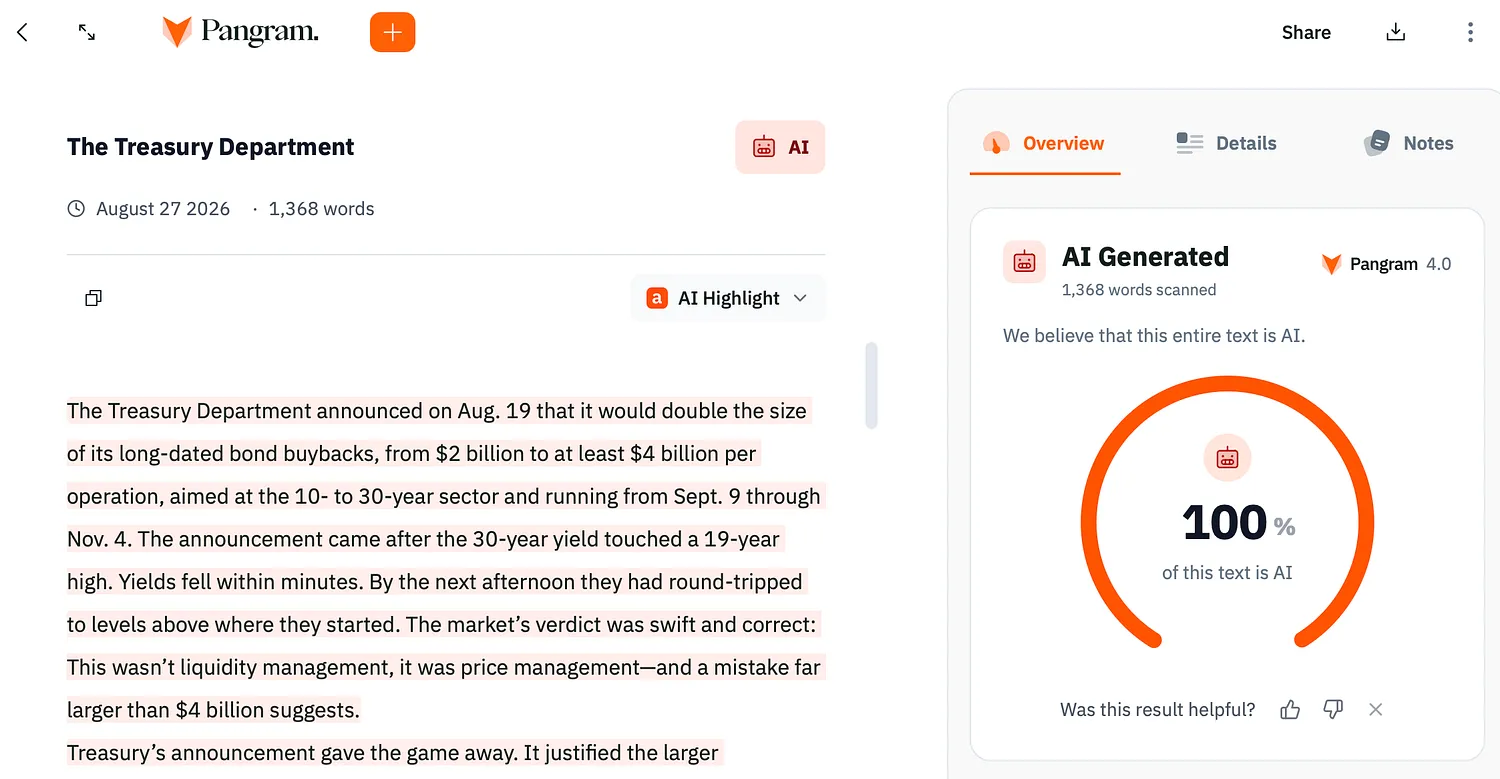 Pangram’s assessment of Druckenmiller’s op-ed
Druckenmiller didn’t deny it, didn’t hedge, and didn’t send a spokesperson out to mumble about “editorial assistance.” He admitted guilt immediately and reached for a calculator analogy. He doesn’t do arithmetic by hand, so why should he write his own words? Then, the Journal’s editorial-page editor backed him up, saying nobody could doubt that the op-ed reflected Druckenmiller’s genuine opinion. Both treated the incident as a giant nothingburger.
I’ve been chewing on this for a few days, and it doesn’t sit right. I should be on Druckenmiller’s side. I just wrote an essay titled The Medium Is the Model arguing that AI is best understood as a medium, not an intelligence. I even encouraged people to use AI to distribute their knowledge.
Ghostwriting has been a fixture of op-ed pages for nearly as long as they’ve existed. If a 73-year-old investor has a view on Treasury issuance and needs help turning his bumblings into prose, that’s fine. Right?
So why did this story make me wince? Why isn’t a calculator the right analogy?
Maybe it’s because a calculator doesn’t voice opinions about math.
Commingled
When you dump half-formed nonsense into ChatGPT and ask for a few hundred publishable words, the model doesn’t just organize your ideas. It injects its own. It connects your intuitions, strengthens your arguments, and suggests conclusions you never reached. Your thoughts and the AI’s thoughts get commingled, and nobody can easily separate them.
Not the editor. Not the reader. Not even the author.
If the WSJ op-ed is 100% Druckenmiller’s thinking dressed up in janky prose, fine. Read it. He’s earned the audience.
If it’s 30% his thinking, it shouldn’t be in the WSJ. I can open ChatGPT or Claude and ask it what an investor might say about Treasury duration risk, and I’ll get similar ideas. The byline was the only reason to read the op-ed.
The byline is supposed to convey the source of ideas. Druckenmiller’s calculator excuse misses the point. Nobody cares which calculator you use, because 2 + 2 = 4 isn’t an opinion. A persuasive argument about Treasury policy is.
Druckenmiller’s mistake wasn’t using AI. It was giving us no way to parse his thinking from the machine’s.
Guinea Pigs
I’m running an experiment, and you’re inside it right now.
If you’ve read my other content, this article probably sounds familiar. It’s written in my voice and reflects my views. Plus, AI models usually don’t throw around phrases like “performative bullshit.”
Except, in this case, an AI model did generate these words. But if you run this article through Pangram, it’ll say 100% was written by a human. That’s true…kind of.
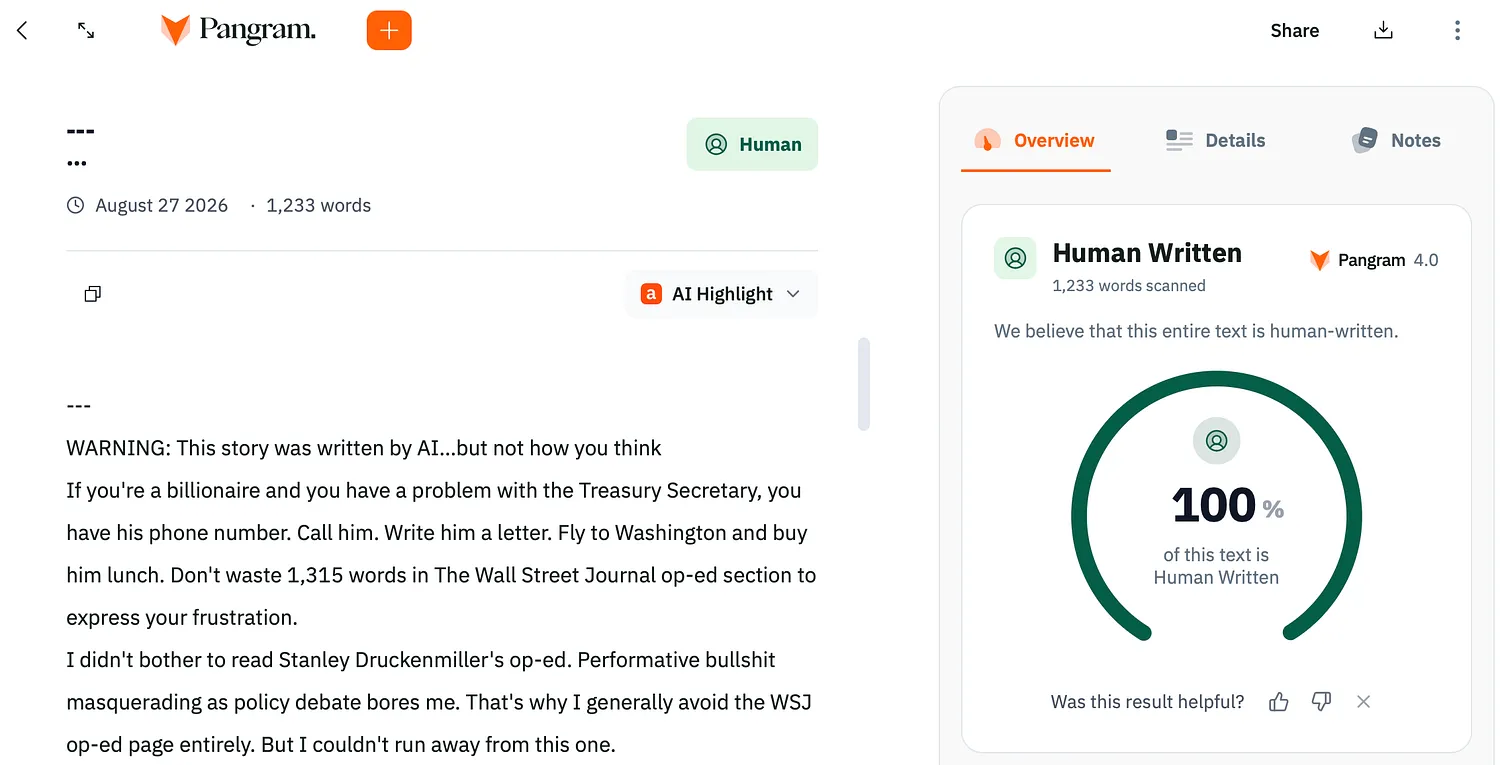 This article’s Pangram score (I call bullshit, Stanley)
Here’s what I did:
- Research: I reviewed the original op-ed, dove into the mechanics of Pangram, and perused the social media meltdown.
- Outline: I drafted an outline for the story I wanted to tell…then I edited it…then I edited it again…and again.
- Record: I talked through the outline, injecting my Rob-isms and ideas into the narrative. Plenty of rambling with a side of wisdom.
- Draft: I handed the transcript to an AI model along with a style guide based on my past writing (SKILL.md file).
- Edit: I refined the AI’s draft until it met my usual standards.
- Publish: I pressed the “Publish” button and crossed my fingers; please be kind!
Maybe Druckenmiller followed a similar process, but I’m going one step further than he did. I’m also publishing the original recording. You can listen to me ramble and compare it to what you just read. Every idea existed in that audio file before it landed on this page.
The recording is my audit trail. It cost me virtually nothing to produce and makes the provenance of this article transparent to anyone who cares.
So, why did I do it? Because most of my ideas never make it to Medium.
Lost to the World
I’ve published almost 40 articles and written an entire book about AI. If you’ve read any of it, I hope it’s obvious that I spend a stupid amount of time on writing and editing. I’m going to keep doing that for nuanced topics.
I created this process to solve a problem in my life. I generate most of my ideas out loud: in conversations with clients, on walks with friends, and talking into my phone at night. Most of that content is lost to the world.
It also solves another problem. I’m terrible at predicting what you’ll want to read. I spent days writing The Rotten Tomatoes of Everything and The Medium Is the Model. Don’t get me started on my Neuroscience Rewired series. Those pieces were read by a few dozen people.
Meanwhile, my Gathering Dust article about virtual reality has been read by thousands of people. Why? I have no idea. It must have struck a chord.
I can’t predict which articles will be popular. The little edge-case ideas that were never going to justify a full week of writing now cost me a walk and an edit. Even if one in ten lands, it’ll be worth it.
This piece was the perfect test case. If you find it insightful or entertaining, terrific. If not, at least it didn’t distract from my usual writing. I’m currently working on two Rob-originals. Stay tuned.
After a few days of reflection, here’s where I landed.
The line between human-written and AI-written content is already fuzzy and will only get fuzzier. What matters is whether readers can trace ideas back to a human mind. If not, they’re better off asking ChatGPT or Claude themselves. AI content is worth about $20/month; it doesn’t matter whose name is on the byline.
Druckenmiller’s mistake wasn’t that he used AI. It’s that he asked us to trust that the ideas were his own. That’s a tough ask when your op-ed scores 100% on the AI detector.
My advice to Druckenmiller (and the WSJ): if you use AI, show your work.
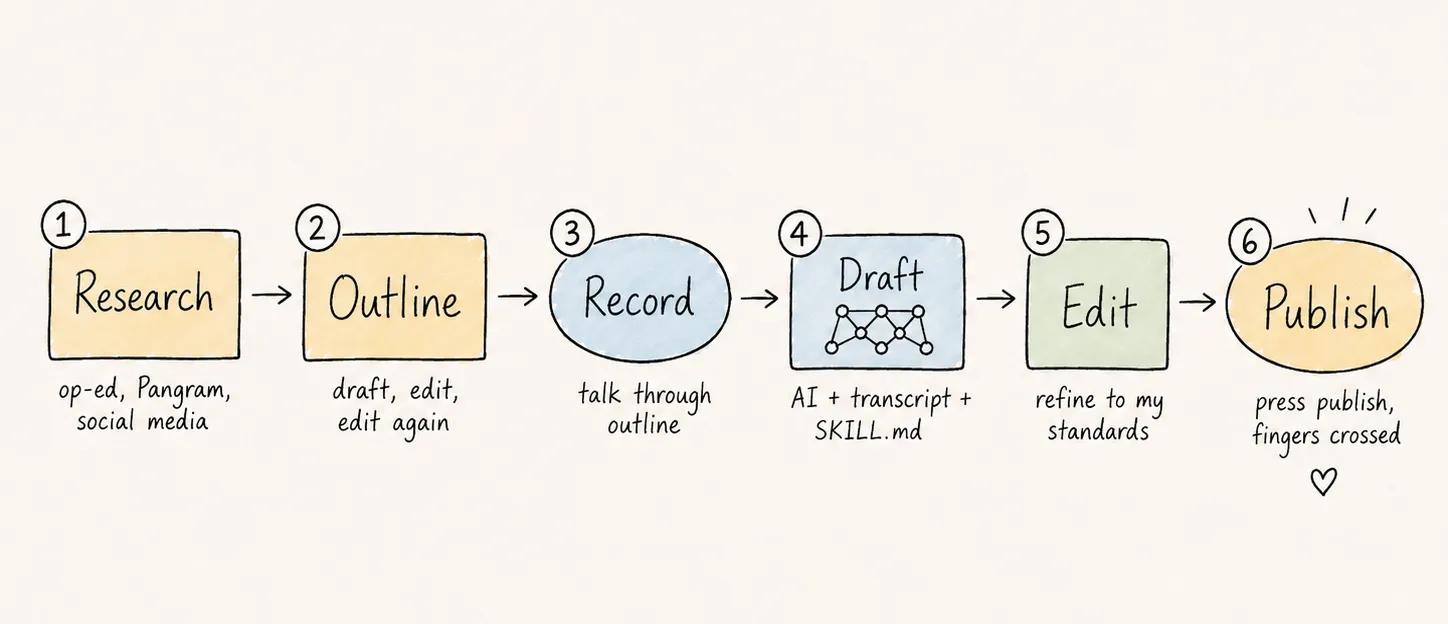 Process I used to write this article (Source: AI generated from my sketch)