
The Medium Is the Model
What if our entire conception of AI is wrong? Maybe it isn’t coming for all our jobs. Maybe it’s wiring us together.
I’ve written this article six different times, even more if you count the drafts churning through my head. I’ve had something to say about AI for months, but I’ve struggled to find the words.
It all started with my LinkedIn feed. I avoid social media, but I sometimes scroll the corporate carousel of pronouncements, pontifications, and promotions. The LinkedIn algorithm sucks, and that’s why I like it.
As I thumbed through my feed, I couldn’t escape the sameness. An AI glow, or stain, depending on your perspective, was creeping across the app.
The experience wasn’t off-putting. In fact, AI has made most people better communicators. Gone are the typos, incoherent bullet points, and crude visuals. Those lamenting the spread of AI slop long for an internet that never truly existed.
The problem is that exceptional content is harder to find amid a rising sea of “good enough” content. We’re trained to search for diamonds in piles of coal. Increasingly, it feels like we’re digging through piles of glass — and the piles keep getting bigger.
 How it feels to scroll LinkedIn these days (generated with AI, of course)
Anthropic CEO Dario Amodei has imagined a “country of geniuses in a datacenter.” OpenAI CEO Sam Altman has made similarly expansive predictions. Maybe they’re right, but humans have an annoying habit of viewing nascent technologies through the lens of our past.
Early takes are usually wrong: electricity was more than a better candle, the automobile was more than a mechanical horse, and the internet was more than a digital library.
By that logic, AI will be more than a mechanical mind.
What will it be? I’m not sure, but I have an inkling. I first saw it in my LinkedIn feed. Now, it’s everywhere I look.
I don’t think we’ll remember AI as the technology that stole everybody’s jobs. AI will be something far more powerful.
Before going further, I want to acknowledge the transitional pain that AI will likely cause. The mechanical horse era sucks when you’re the horse. Many people will be left behind, and we owe them a path to catch up. We shouldn’t pick AI winners and losers in the mechanical horse era.
Connective Tissue
Imagine you’re a hunter-gatherer living 250,000 years ago. Take stock of what you know. Which plants can you eat? Which animals should you avoid? You’re intelligent in many of the same ways as the other hunter-gatherers around you.
Now fast-forward to today. Think about how different your intelligence is from that of your family, friends, and colleagues. There’s still overlap, but far less than in hunter-gatherer times. Humans specialize over time.
People are obsessed with individual intelligence, but collective intelligence is what matters. By collective intelligence, I mean the sum of our individual intelligences, less any redundancies (e.g., lots of us know how to drive).
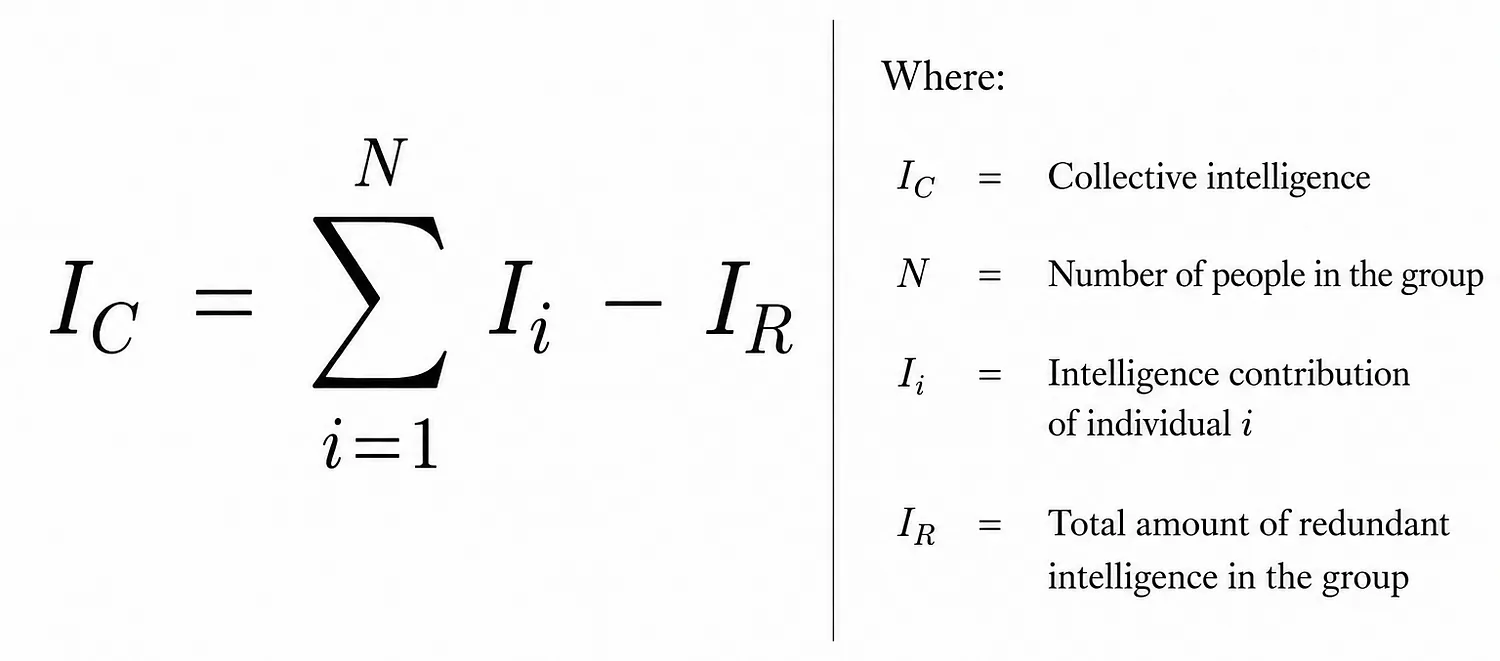 My non-scientific collective intelligence formula
The redundancy part is important. Eight billion hunter-gatherers couldn’t sustain a modern civilization. We need accountants, teachers, doctors, and YouTubers, each possessing a measure of specialized intelligence.
Side note: Redundancy is critical for resilience, capacity, error correction, and shared understanding. I’m not implying redundancy is wasteful; it simply limits how much brain capacity humans can dedicate to truly unique knowledge, judgment, and skills.
The problem with specialized intelligence is that it’s not terribly useful in isolation. Could you build a smartphone from scratch? What about a pencil? At this point, most of us couldn’t even survive a month in the wilderness without help from a survival specialist.
Media — and I’m using that term broadly — is the connective tissue that binds specialists together. It’s how specialists share information and coordinate with other specialists across space and time.
We’re not the only animals to use media. My dog shares information with the neighbor’s dog all the time. She turns her thoughts into sound waves and pushes them through the air. I have no idea what she’s saying, but it sure sounds important.
Light and air are convenient media because they’re ubiquitous. They’re also lossy, ephemeral, and local. You can’t operate a complex society on gestures and spoken words alone. Also, contrary to what my dog thinks, pee has its limits too.
Fortunately, humans keep inventing new media technologies. Today, we share information using symbols (writing), electromagnetic waves (radio and television), and, most recently, bits and bytes (the internet). Each media innovation unlocks fresh avenues for specialization.
Importantly, new forms of media don’t replace old ones. We kept talking to other people even after we could email them. Each medium has tradeoffs, and we bounce effortlessly between them.
Okay, but what does any of this have to do with AI?
Web of Numbers
The building blocks of artificial intelligence are parameters. In isolation, a parameter is just a number. Together, vast quantities of them form a model that encodes patterns found in its training data. I won’t go into the mechanics here, but I recommend checking out the Financial Times primer if you’re curious.
Researchers introduced the first mathematical model of an artificial neural network in 1943. The story you’ve probably heard is that proliferating data and cheap compute finally made AI possible. It’s a story of steady progress punctuated by serendipitous innovation.
I have a different story.
Think about how much time you spend creating presentations, writing emails, replying to texts, and scrolling content. Today, most of us spend more time coordinating with other people than learning, thinking, and reflecting on our own. It all feels exhausting and unsustainable.
Along comes AI. Models compress the internet by a factor of a billion, from zettabytes to terabytes, and make it easier to navigate. You just put tokens (e.g., words, images, sounds) into one side, and out pop new tokens, continuing the sequence you started.
AI models are what I imagine a crack team of researchers might invent if you tasked them with fixing the internet. The design requirements would be something like “make it easier to navigate, get rid of all the superfluous stuff, and shrink it down to fit on a hard drive.”
Like every other form of media, AI models come with tradeoffs, including transparency, predictability, attribution, and control. That’s why they won’t replace writing or the internet. We accumulate media technologies; we rarely discard them.
Today, we find ourselves in another AI hype cycle. The previous two ended in AI winters, painful reminders of what happens when a technology arrives before the world has figured out what to do with it.
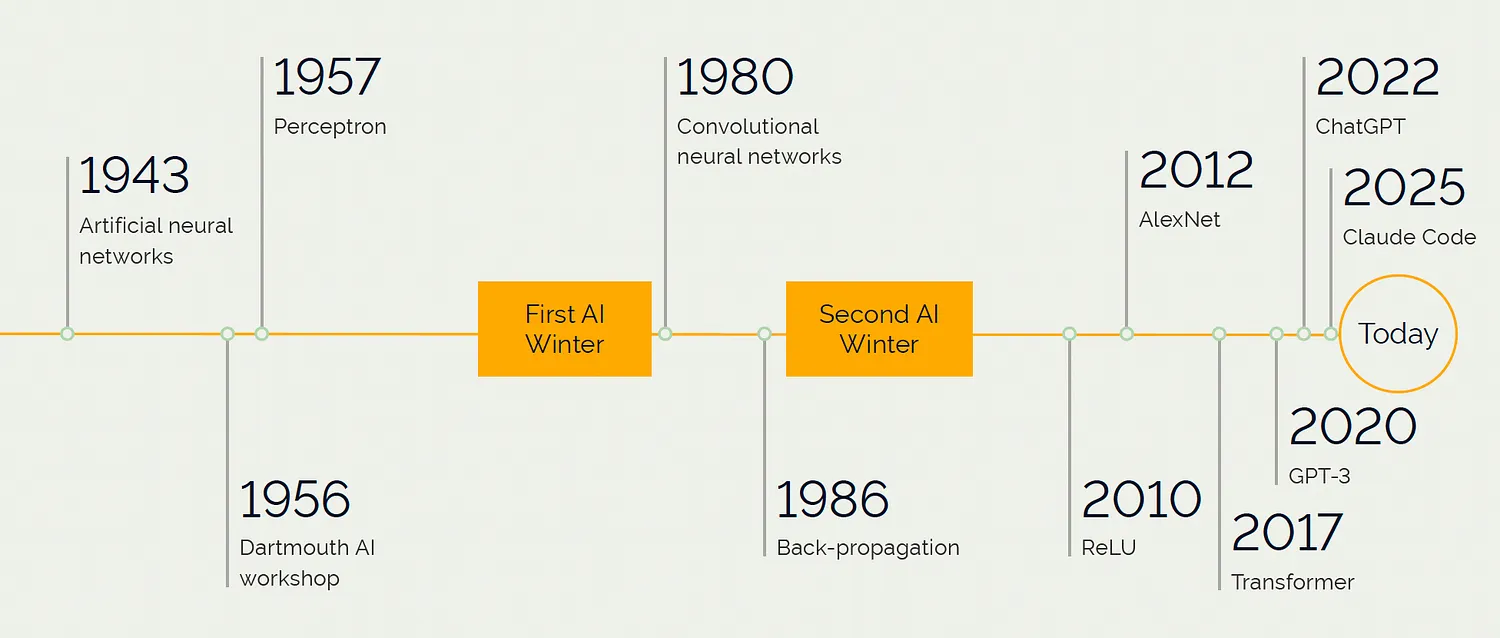 Eighty years of artificial intelligence
Now, we may finally have a problem worth solving. The burnout you feel at work, and in life more broadly, is a symptom of legacy media straining under the weight of progress. For the first time, it might be worth investing the trillions of dollars required to make AI work.
The term “artificial intelligence” was coined long before we knew the full potential of the technology. Those two words have shaped our thinking about what AI is and isn’t. It’s hard to think of AI as anything other than intelligence — it’s literally in the name.
But are models truly intelligent? Most people wouldn’t claim a book or the internet is intelligent. A medium contains intelligence; it isn’t intelligent on its own.
Is AI any different?
Side note: I realize that models are just bits and bytes behind the curtain, but AI can still be a separate medium. Radio and television are different forms of media even though they both use electromagnetic waves.
Looking in the Mirror
What happens when you type words, upload images, or talk nonsense into ChatGPT? Most of the time, the model generates a sequence of words, pixels, or sounds that matches what you expect.
Imagine if, instead, you sent your prompt to a Fortune 500 company. For the next week, employees dropped everything and toiled on your request. Would the company’s response be as good as ChatGPT’s?
We don’t have to speculate about superintelligence; it’s already here. The phone in your pocket, the clothes on your back, and the built environment around you are evidence. We raced beyond the limits of our individual intelligence millennia ago.
When you use an AI model, you’re witnessing humanity’s collective intelligence reflected back at you — or at least what’s in the training data. Most of that intelligence you could find on the internet if you had enough time and knew where to look.
I don’t want to minimize the profound implications of cheap and easy access to humanity’s collective intelligence. I created AretaCare for a close friend to help manage his mother’s healthcare. I built the first version of the app in 48 hours with my $100/month Claude subscription.
Could a team of professionals have done a better job? Of course, but that option was prohibitively expensive. Could I have learned the skills needed to build the app myself? Probably, but not in 48 hours. AI provided cheap and easy access to the intelligence I lacked.
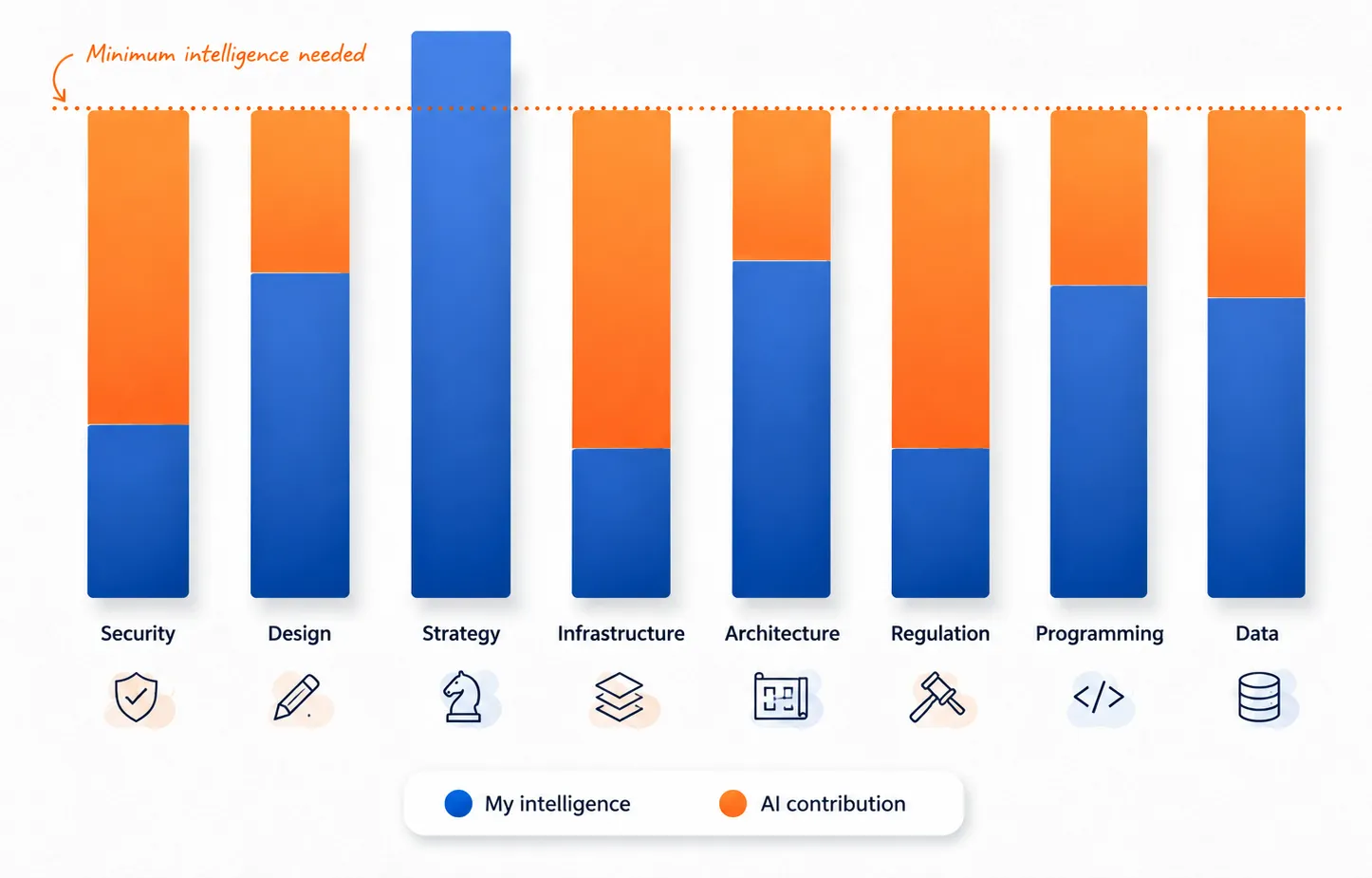 Illustration of AI filling the gaps in my intelligence (AretaCare example)
If AI can build an app in 48 hours, what’s stopping it from creating new drugs, drafting legal briefs, and writing all those TPS reports? Surely, humans will be pushed out of the workforce by faster, cheaper, and more capable AI.
There are two flaws in that line of reasoning. First, it assumes economic output is fixed. I was never going to hire professionals to build AretaCare. AI took a job that never existed.
Second, and more importantly, it only considers how AI is useful to people who consume intelligence. Could AI also be useful to people who produce it?
The 1%
If you use AI long enough, you’ll notice a quirk: the better you know a topic, the less impressive AI seems. I find AI to be a decent contract lawyer and a lackluster management consultant. An experienced lawyer would probably reach the opposite conclusion.
Your expertise shapes your perception of AI. Specifically, the uniqueness of your specialized intelligence determines how impressive AI seems.
I’m not talking about “specialized intelligence” in an academic sense. You don’t need a PhD to have it — though that can help. For example, I know a lot about AI roadmaps. If you ask ChatGPT to generate one, it’ll give you a fine answer. Mine will be better.
We all have specialized intelligence shaped by life experience. Think hard enough and you’ll find something you know better than most people in the world. It may be weird or economically useless intelligence, but it’s yours.
Most of us work for one organization at a time. Maybe a few more if you’re a freelancer, gig worker, or (mostly) retired consultant like me.
We’re paid to do all sorts of tasks. Some of those tasks make use of our specialized intelligence, but most don’t. For example, nobody should pay me to build a PowerPoint deck or troubleshoot a GitHub issue. Those tasks aren’t below me; I’m just not very good at them.
In an ideal world, I’d work with hundreds of organizations concurrently, providing each of them with the specialized intelligence they need at precisely the right moment. I’d be “in the room” for every AI roadmap conversation. Organizations would pay for what I do best and nothing more.
The world I’m describing wasn’t possible with legacy media. Imagine trying to coordinate Zoom calls with hundreds of specialists. Or picture yourself combing the internet for every relevant research paper, article, blog post, and book ahead of a major decision. I’m exhausted just thinking about it.
All that’s possible with AI. You don’t need to understand every detail of every situation. You can encode your specialized intelligence and use AI to broadcast it to the world. Better yet, AI can seamlessly bundle it with the intelligence of other specialists.
I’ve been testing this theory for the past few months using a skills gateway (zerocosine.com). I won’t go into the technical details, but think of it as Google for AI agents. It works surprisingly well.
We’re stuck in the mechanical horse era because we’re trying to wedge AI into a society built around legacy media. Most jobs employ a dollop of specialized intelligence and a heap of general intelligence. That ratio needs to flip, and in time, it should.
Side note: I’m using “general intelligence” to mean knowledge, judgment, and skills shared by many people. I realize that differs from the term’s traditional meanings in psychology and AI.
Most of general intelligence is redundant. That’s one reason AI models can compress the internet by a factor of a billion. There’s plenty of signal in the noise, but we don’t need a billion people knowing how to drive a car. By periodically offloading general intelligence to AI, we can free up capacity to build new specialized intelligence.
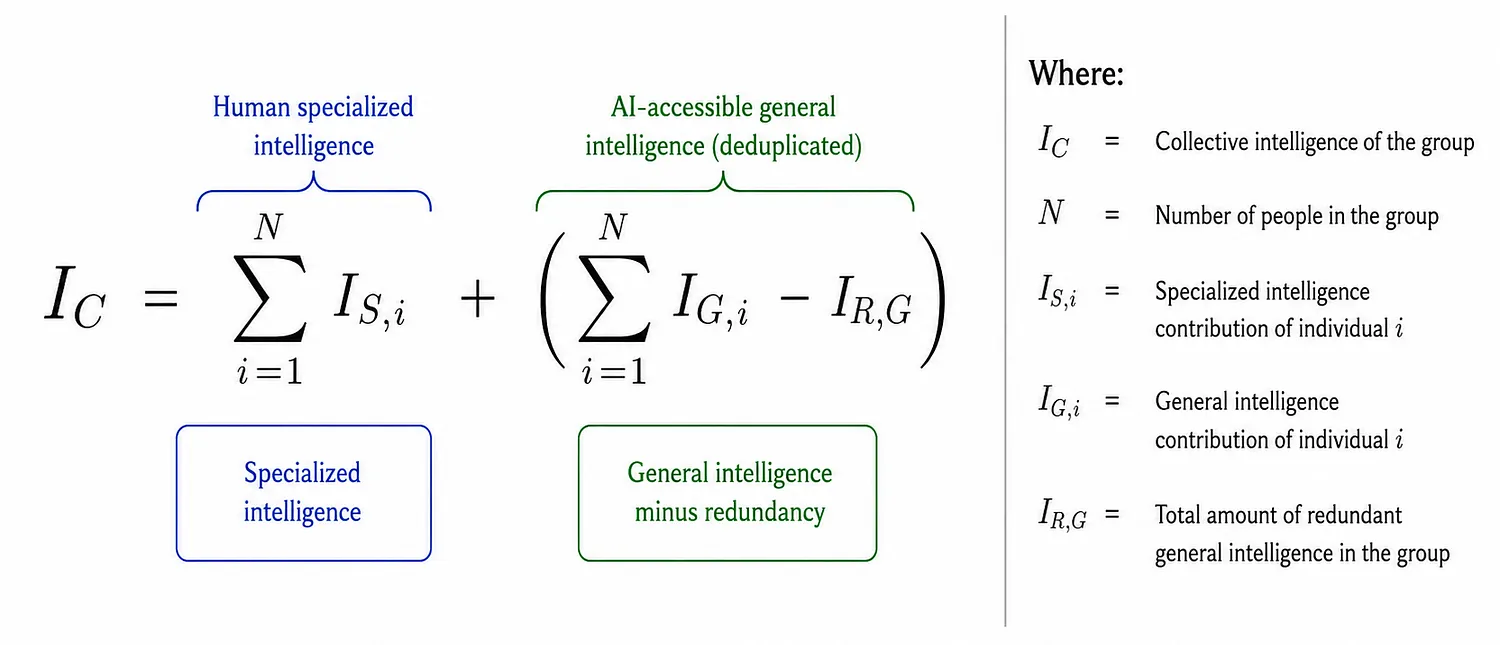 Updated formula splitting specialized and general intelligence
The jobs we think of as specialized today — podiatrist, Montessori teacher, fixed asset accountant, management consultant — may sound impossibly broad to future generations. We might even lose the ability to define ourselves by our job titles. Oh, the horror!
I think a society that rewards learning, thinking, reflection, and unique experiences sounds wonderful. I’m tired of this overwrought complexity machine fueled by attention. I understand why it exists, but we can do better.
You probably read that last paragraph as a critique of social media, but I’m referring to attention more broadly: meetings, emails, texts, and content all compete for it. That said, social media is an excellent place to start if we want to avoid repeating the mistakes of the past.
Awake at the Wheel
If AI is a medium, we should worry about who controls access, distribution, and monetization. I’m not a policymaker, so treat what follows as a provocation rather than a prescription. That said, we should be properly pissed about the bargains we struck with social media. Making the same mistakes with AI could be much worse.
First, specialists should have open ways to distribute and monetize what they know. We can’t allow publishing houses, academic journals, and AI companies to gatekeep specialized intelligence. Their economics depend on controlling access, and too little of the value flows back to creators. We need open markets for intelligence, not another generation of entrenched intermediaries.
I built ZeroCosine to demonstrate it’s possible to give AI models access to specialized intelligence while protecting intellectual property. Model parameters aren’t updated after every turn. That’s a feature, not a bug. You can sell content to a human once. You can sell content to AI again and again.
Second, AI companies should be held responsible for harmful conduct, including their own design and distribution choices. Section 230 solved a real problem, but it created a new one. It allowed social media platforms to scale without being treated as the publisher of every post. Over time, courts often extended that protection to claims involving how platforms ranked, recommended, and amplified harmful content.
Platforms decide who gets access and set the terms of service. Advertising may have created the attention economy, but liability rules determined who bore the costs. Fortunately, Congress hasn’t yet given AI companies the same broad liability shield. Let’s keep it that way.
Third, governments should regulate concrete harms without controlling lawful expression. That may seem at odds with my previous point, but there’s a difference between regulating a medium and controlling it.
National-security agencies have a legitimate role when AI creates concrete military, cyber, or biological risks. But they shouldn’t become the default regulators of expression and commerce.
For most civilian uses, the agencies overseeing AI should look more like consumer-protection, civil-rights, and communications regulators than intelligence agencies. We should fight passionately against licensing regimes and government-appointed arbiters of truth. A healthy system regulates harmful conduct, not viewpoints.
If we get this right, AI could free us from the anxiety that’s come to define modern life. Specialization rewards learning, thought, reflection, and experience over multitasking, churning, flailing, and scrambling.
If we get it wrong, we could spend another generation trapped inside a prison of our own making. AI is incredibly powerful, and it can easily devolve into an attention machine if we’re not careful. The path social media took was a choice, not an inevitability.
Let’s not zuck it up again.
A Distinction Without a Difference
I can’t tell whether the “AI as a medium” story is true or just something I want to be true. I’ve spent a decade thinking and writing about AI as a mechanical mind. I sometimes struggle to believe my own words.
An obvious rebuttal to my argument is that AI can act as an independent agent. It can do things on its own, beyond direct human control. Your television can’t do your taxes.
But haven’t media technologies been acting on the world in ways we don’t control for centuries? Isn’t that the entire point of Marshall McLuhan’s famous line, “The medium is the message”?
Only time will tell whether AI is a mechanical mind, a powerful medium, or something else entirely. New technologies are always weird and unpredictable — exciting and terrifying.
The one thing I’m confident about is that today’s narratives will look silly in hindsight. They always do. Technologies like AI don’t fit neatly into existing boxes; they reshape them. If you’re looking for a reason to be optimistic about AI, today’s prevailing pessimism is a great place to start.
It’s still early. This story is far from over.