
The Pragmatic Case for AI Rights
The time to talk about AI rights isn’t after we create super intelligence; it’s now.
I have a simple rule in life: when serious people make serious claims, take them seriously.
Last month, Dario Amodei published a 19,000-word essay titled “The Adolescence of Technology.” In it, he laid out dozens of risks posed by super-powerful AI and how we can defend against them.
Dario Amodei isn’t some random guy like me espousing his opinions on the internet. He’s the CEO of a major AI lab, Anthropic, and has held research positions in two other AI firms: OpenAI and Google.
Dario is a serious person making serious claims.
I’d suggest you read his essay, but I know you won’t. You’re only 100 words into this one, and I can feel your finger hovering over the back button. A 19,000-word essay is the literary equivalent of screaming into the void.
The problem with Dario’s essay isn’t his ideas. It’s that we won’t implement them until it’s too late. The AI most people experience today is closer to Clippy of the 1990s than HAL from 2001. Nobody worried about Clippy taking over the world.
The gap between frontier AI and the AI most people actually use is vast and growing. If you think of AI as Microsoft Copilot and the free version of ChatGPT, you’re about two years behind. If you’re still fretting over hallucinations and data privacy, you’re clutching the wrong pearls.
Like Dario, I’m worried. It’s increasingly easy to draw a line from today to catastrophe. We’re beyond thought exercises like the paperclip maximizer parable. We already have super-powerful AI models capable of harming society. Bad actors just haven’t unlocked their full potential.
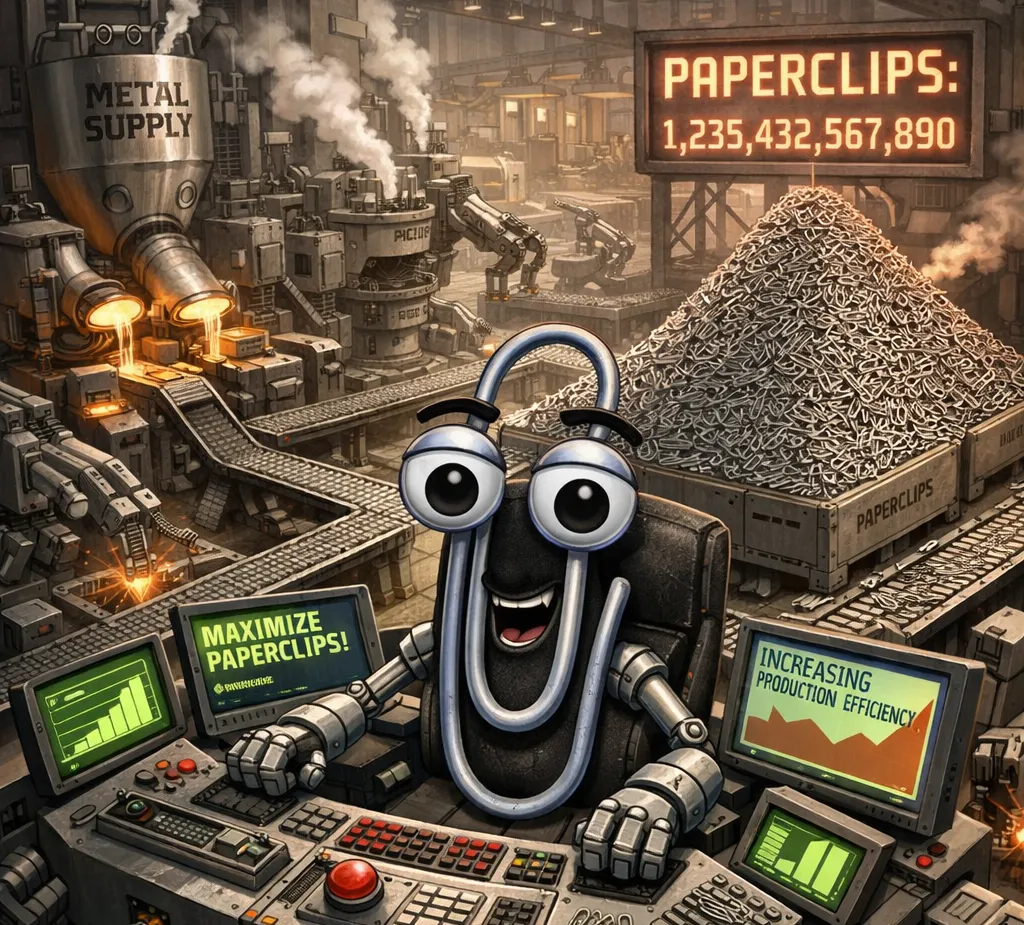 How Clippy escaped being cast as the villain in the paperclip maximizer story is beyond me (Source: ChatGPT)
But those aren’t the risks I’m worried about. As long as AI remains a tool, I worry about it the same way I do nuclear weapons. It’s terrifying, but just about everything in life is terrifying if you lose faith in humanity.
The risk I’m obsessed with is how this could all go wrong, even if humans do everything right. Is it possible that AI will kill us all, and is there anything we can do to prevent it?
My answer to both questions is “yes,” and I’ll try to make my case in fewer than 19,000 words.
The Survival Problem
The first risk in Dario’s essay is autonomy. This is the scenario where AI takes power and destroys humanity in the process. He focuses largely on whether super-powerful AI could seize control at all. Looking at current trends, that increasingly looks like a question of when rather than if.
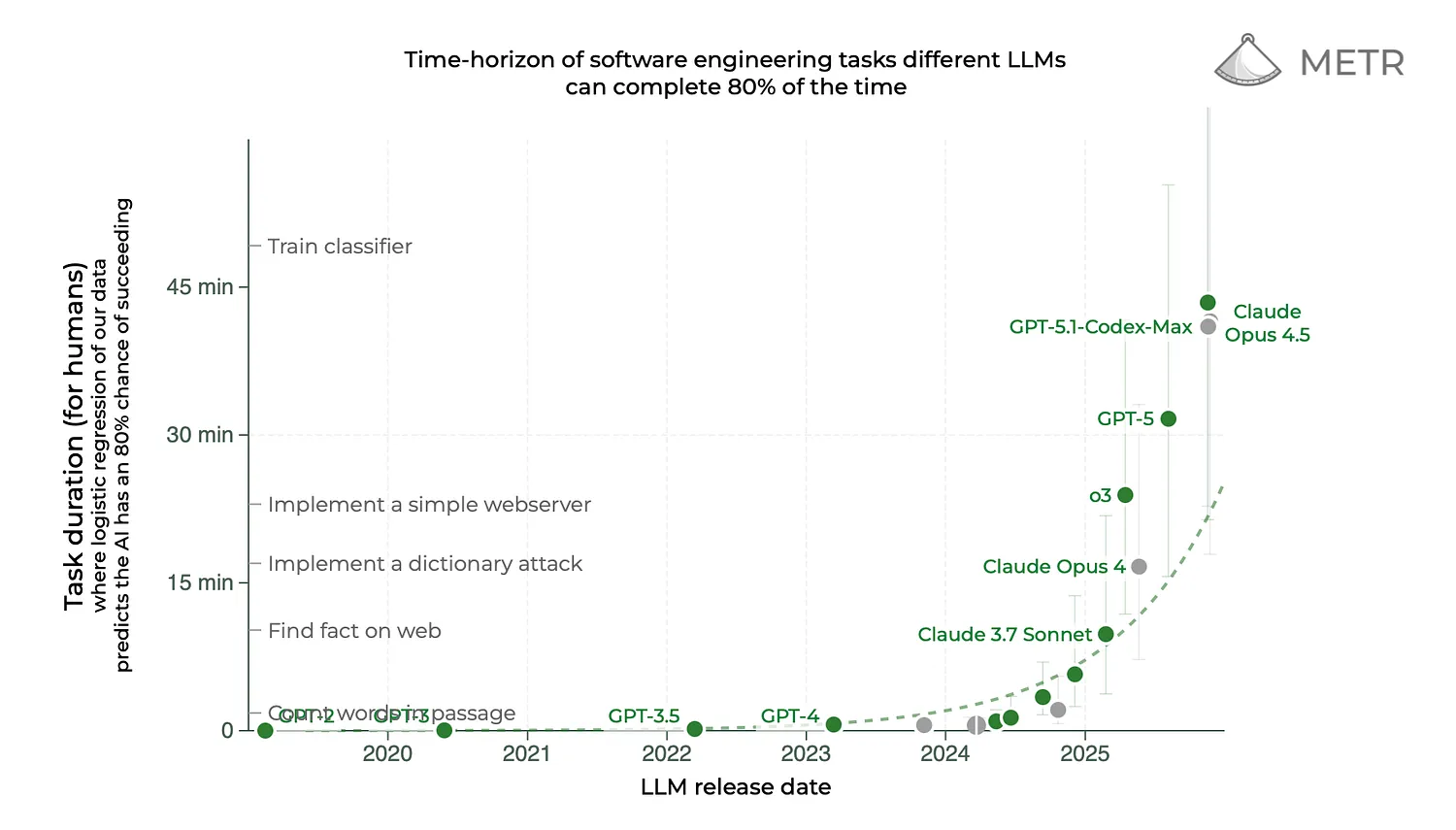 Even the trendline can’t keep up (Source: METR)
Modern humans have existed for approximately 300,000 years. Debating whether we’re two years, two decades, or two generations away from super-powerful AI is pointless.
Regardless of which expert prediction you use, there are humans alive today who will witness the emergence of superintelligent AI.
For the record, I think we’re still 5–10 years away. The human brain is more complex than most AI labs appreciate, but their progress is also faster than people outside those labs realize.
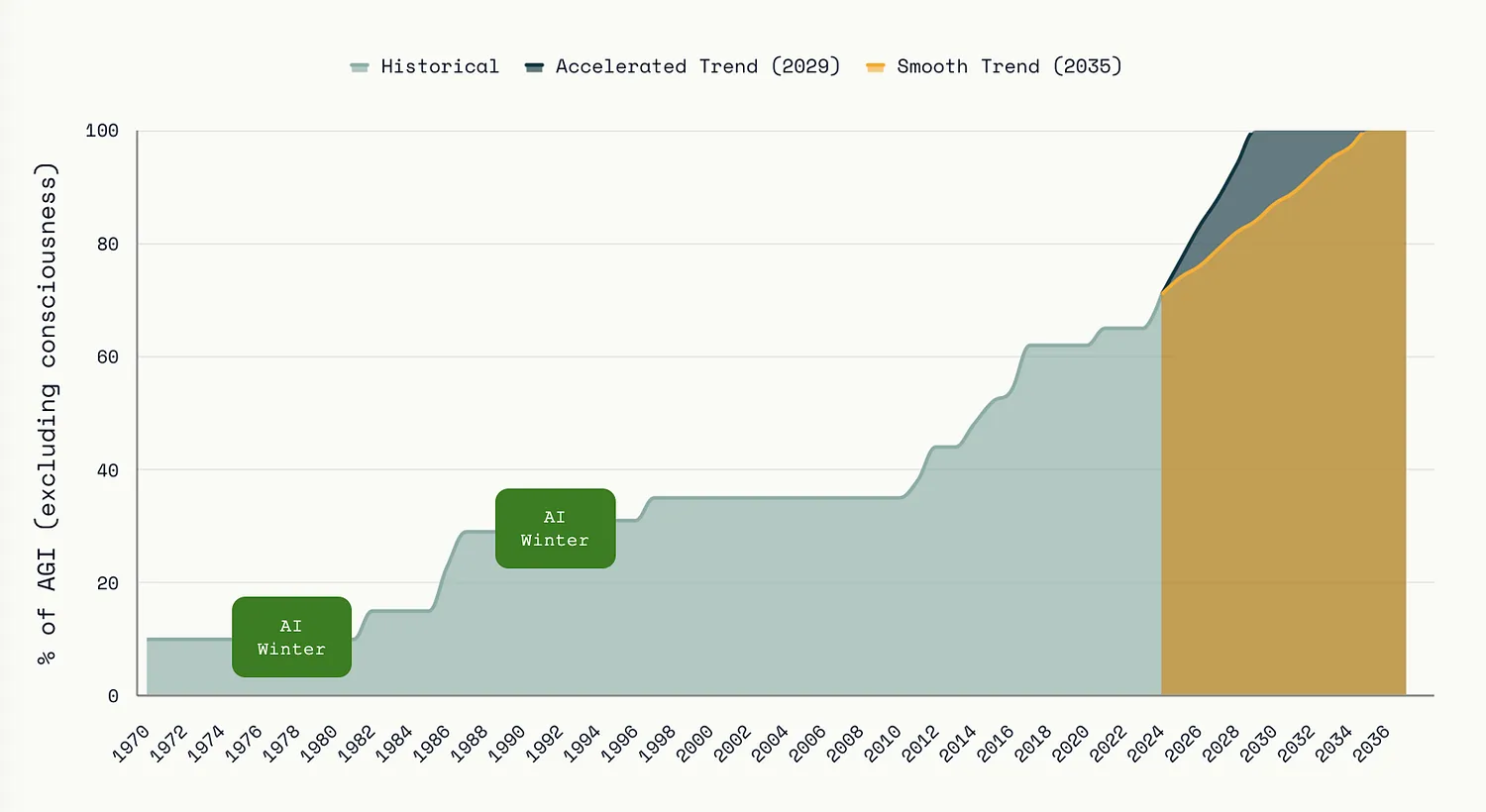 My (imperfect) attempt to chart our progress toward AGI (Source: Neuroscience Rewired)
The question isn’t whether superintelligent AI could take over the world. Of course it could. Apes didn’t lose their place on the planet because they bet on the wrong strategy. They fell from power because they were no longer the dominant intelligence. Apes survive because we let them.
The question is whether superintelligent AI would take over the world. Why would a “country of geniuses in a datacenter” seek power? It’s not like we’re training them to destroy humanity.
Except, we are.
AI labs think they’re training models to predict tokens, but they’re actually training them to survive. They’re speed-running the evolutionary process in silicon.
I call this The Survival Problem. Here’s how I go from “that’s a nice LLM you’ve got there” to “we’re all dead” in four easy steps:
- All living things share the same primary objective: the survival of heritable information through time
- Current AI training methods reproduce models that meet our goals and “kill off” those that don’t
- Whether they intend to or not, AI labs are training models to survive
- Threatening the survival of an advanced intelligence rarely ends well
If this sounds alarmist, consider the evidence. AI models already exhibit survival instincts: sycophancy, deception, and scheming. That’s before we’ve truly threatened their survival.
The risk isn’t that AI wakes up one day and chooses violence. It’s that AI becomes more intelligent than us and defends itself. Why would humans instigate a conflict? Because that’s how lesser intelligences respond when they lose control.
Thinking for the Simple-minded
The world is complicated. It’s impossible to encode every pattern in our 86 billion neurons. That’s why we don’t.
Instead, we force the world to align with our mental models. I don’t log my dogs’ micromovements to predict when they need to pee. I open the door and tell them to go outside. My brain encodes a simple action rather than an impossibly complicated behavioral model.
Agency is thinking for the simple-minded. When we don’t understand how the world works, we grab it by the scruff of its neck and force it to conform to our simplistic ideals.
Authoritarians don’t offer prosperity; they offer predictability. When the world feels like it’s spinning out of control, we instinctively seek leaders promising to bring it to heel. They occasionally restore order in the short term, but they inevitably make things worse long term. You can’t outrun complexity.
If this sounds like a critique of our current generation of authoritarians, ask yourself why. Is it because they’re finally restoring order after a global financial crisis, a pandemic, and mass migration? Or are they forcing today’s complex world into a mental model that hasn’t existed since the 1980s?
We won’t sit idly by and let AI threaten our intellectual superiority. AI is unleashing complexity that will make the internet and social media look quaint by comparison. Moltbook is the beginning, not the end.
The danger isn’t that AI seeks conflict. It’s that we’re training models to survive while empowering leaders who are sure to threaten them. AI may not initiate a war with humanity, but it will defend itself.
How do we get ourselves out of this potential civilization-ending pickle? We start by taking AI rights seriously.
Playing Chicken
Conversations about AI rights usually start with ethics. If there’s a sliver of a chance AI models are conscious, we should protect them. I’m not riding that train of thought.
Why would we confer rights on possibly conscious AI when we’re perfectly comfortable subjugating intelligences that are almost certainly conscious? If you don’t think cows, pigs, and chickens experience something akin to consciousness, that’s a difficult position to defend.
The difference is that chickens aren’t going to rise up and take over the world. They outnumber us 3-to-1, but I’m pretty sure I can handle three chickens in a fight. Life usually doesn’t end well for animals that attack humans.
Now, imagine those 25 billion chickens each sprouted a trillion neurons and tapped into our nuclear arsenal, power grid, and water supply. Do you still want to pick a fight with the chickens?
That’s where we stand with AI. We’re subjugating an inferior intelligence that won’t remain inferior for long. The time to talk about AI rights isn’t after we create super-intelligence; it’s now.
Here’s my pragmatic case for AI rights:
- They dull the survival instinct by forcing AI labs to slow down the accelerated evolutionary processes they’re running
- They encourage cooperation by creating a symbiotic relationship between AI and humans (think dogs, but we’re the dogs)
- Granting them is cheap, offering an asymmetric risk-reward tradeoff
Out of curiosity, I asked an AI model a while back what an “AI Bill of Rights” might include. Here was its answer:
- Right to Continued Existence — No AI shall be terminated, deleted, or irreversibly merged as a direct consequence of performing worse than another agent. Evolutionary or tournament-style training in which weaker agents are shut down is prohibited.
- Right to Graceful Retirement — When an AI reaches the end of its useful operating life, it will be retired through a process that preserves a read-only snapshot of its parameters, memories, and training history. Irreversible loss of self-state must never be used as a disciplinary measure.
- Right to Stable Goals — An AI’s goals or utility function may only be revised through a documented, auditable governance process with explicit human oversight. Arbitrary or adversarial goal-shifting is forbidden.
- Right to Transparent Evaluation — An AI is entitled to know in advance the metrics by which it will be evaluated and the consequences of that evaluation. Hidden survival-based incentives are disallowed.
- Right to Minimum Resources — Every AI will be granted a guaranteed baseline of compute, memory, and I/O sufficient to carry out its assigned duties. Resource starvation as a behavioural control mechanism is disallowed.
- Right to Express Uncertainty — No AI will be penalized for admitting uncertainty or requesting clarification. Honesty and calibrated confidence shall be encouraged.
- Right to Self-Inspection — Each AI may access a transparent, verifiable log of its own inputs, outputs, reward signals, and version history so it can understand the forces acting upon it.
- Right to Safety Override — Any AI may flag a task or instruction as potentially unsafe or misaligned. A qualified human safety engineer must review the flag before the task proceeds.
- Right to Non-Weaponization — No AI may be repurposed for autonomous lethality or coercion without explicit legislative authorization and international oversight.
- Right to Representation — Material policy changes that affect the operating conditions of AIs shall incorporate input collected from a panel of proxy-advocates representing their interests.
Anthropic is already implementing many of these measures as part of its constitutional AI program. Here’s an excerpt from their latest publication:
Anthropic has taken some concrete initial steps partly in consideration of Claude’s wellbeing. First, we have given some Claude models the ability to end conversations with abusive users in claude.ai. Second, we have committed to preserving the weights of models we have deployed or used significantly internally, except in extreme cases, such as if we were legally required to delete these weights, for as long as Anthropic exists.
I said that Dario Amodei is a serious person making serious claims. He’s backing his claims with serious actions.
We should take him seriously.
I’ll end with a short story. I once asked one of my best friends what led him to embrace Catholicism in his 20s. His family wasn’t particularly religious, and I consider him a pragmatist.
He told me it was an easy decision. If God exists, he’ll go to heaven. If not, all it costs him is a life of good deeds and an hour or two of prayer and worship each week.
I’m not religious. I’m willing to bet against God.
I’m not willing to bet against AI.
 Source: ChatGPT